
Contra Costa VINELink Coverage
California VINE, often reached through VINELink, is the custody-status and criminal-case-notification layer referenced by the Contra Costa Sheriff. The Sheriff In-Custody Locator points users to California VINE for custody-status changes and criminal case information. The Sheriff also has a VINE victim-notification page that sends users to the state VINE service to learn about custody status.
That local connection matters because Contra Costa does not publish an official 24-hour or 72-hour release list in the Sheriff jail interface found in the research. The public locator is current-custody oriented. VINE fills part of the gap for a named person by giving status-change alerts and custody-status leads from participating agency feeds. It is still a notification tool, not a certified release packet.
California VINE is reached at vinelink.vineapps.com/state/CA, and the research found a California VINE phone number of 1-877-411-5588. It should be used for a specific person, not as a broad county release feed.
Search Contra Costa on VINELink
A careful VINELink search starts before the VINE screen. Gather the person's full legal name, date of birth or age if known, booking number or agency ID if known, and the last likely facility. For Contra Costa County, that may be Martinez Detention Facility, West County Detention Facility, Marsh Creek Detention Facility, or a state-prison record after a CDCR commitment.
- Search the Contra Costa Sheriff In-Custody Locator first if the person may still be in county jail.
- Open California VINE and choose the California search path.
- Search by name, and use an ID or booking number if the system offers that field and the number is known.
- Compare possible matches by age, custody agency, case or custody number, and location.
- Open the matching record and read the custody status before registering for notices.
- If no result appears, check the Contra Costa County released inmates path through court records, Sheriff records, CDCR, BOP, or ICE as the custody type requires.
Common names need extra care. A VINE match should be treated as a lead until identifiers line up with the court, booking, or CDCR record.
Contra Costa VINE Layer
The local VINE layer is not an optional add-on in Contra Costa. The Sheriff locator itself sends users to California VINE for custody-status changes and criminal case information, and the Sheriff has a separate VINE page. That makes VINE the official notification fallback when the county locator does not provide a historical released-person view.
The California VINE screenshot below comes from the successful manifest row for the recent-release and VINELink context. It fits this page because it is the state VINE entry point used for Contra Costa County release and custody-change checks.
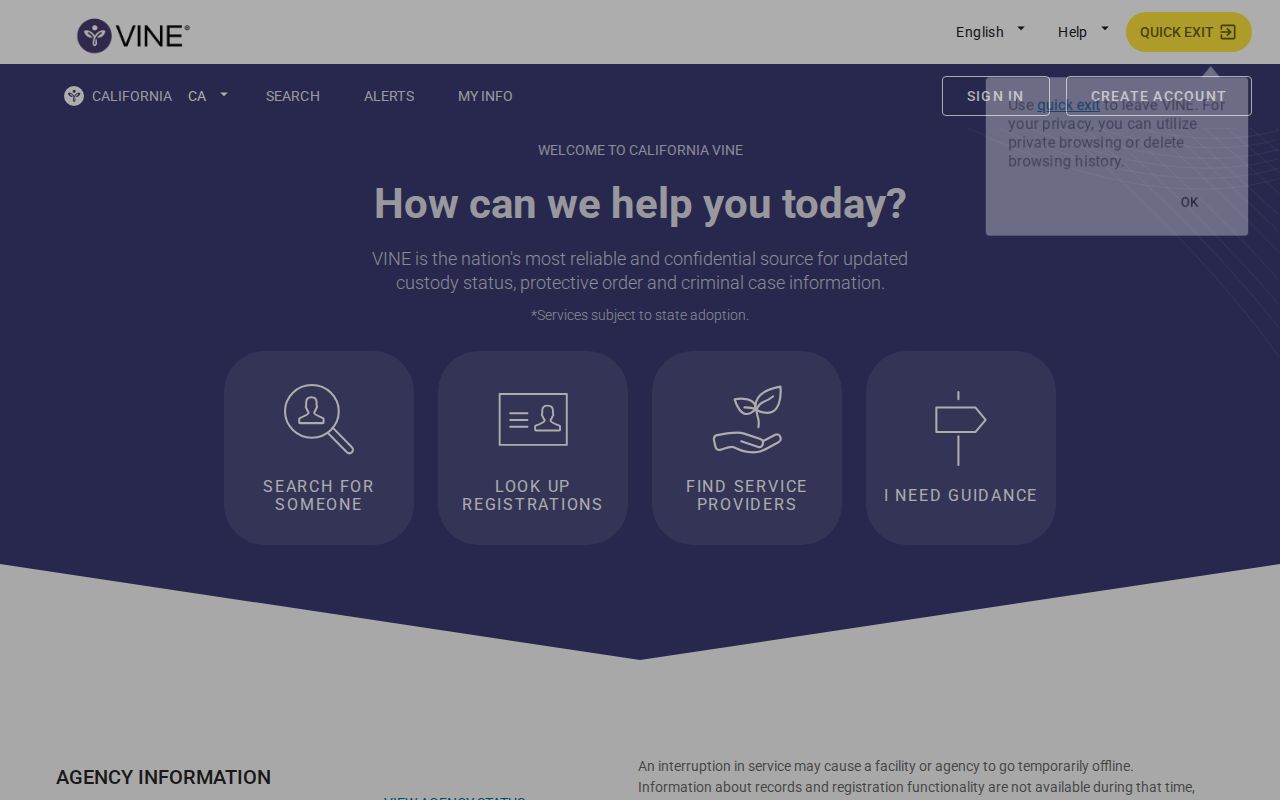
Use the screenshot's source as the starting point, then confirm any important release fact with the agency or court record that created the custody event.
What VINELink Shows
VINE displays custody status based on agency data feeds. A released result may say the person is no longer in the reporting agency's custody and may show a release date, release time, or status label depending on the feed. Fields can vary. The safest reading is that VINE shows notification status and custody-status information, not the complete legal reason for release.
For Contra Costa County, read the reporting agency line with care. A county jail result may refer to Sheriff custody. A state-prison result may point toward CDCR. A case record may belong in Contra Costa Superior Court even when the custody status is no longer active. The VINE record is strongest when it is matched to a booking number, custody number, age, location, or court case that identifies the same person.
| VINELink field | How to read it |
|---|---|
| Name and identifiers | Use to compare against booking, court, or CDCR details before relying on a match. |
| Custody status | May show in custody, released, transferred, or another status-change label. |
| Agency or facility | Shows the reporting agency or custody location when supplied by the feed. |
| Custody number or case number | Helps distinguish people with similar names. |
| Release date or time | May appear when the agency feed supplies it, but exact display varies. |
| Notification options | Shows how to register for calls, email, text, TTY, or app notices where available. |
Register for Contra Costa Alerts
VINE registration is built for status changes. It is most useful when a person is still in custody or may soon move, be released, return, or transfer. Registering after a release may still provide a status lead, but it may not reconstruct the whole custody history. Keep the court and records path ready when the legal reason matters.
- Select the matching VINE record after checking identifiers.
- Choose the notification option, often labeled "Get Notified" or similar.
- Select phone, email, text/SMS, TTY, or app notification where offered.
- Enter contact information carefully so notices route to the correct person.
- Create a personal identification number for phone notices when VINE asks for one.
- Confirm the registration if prompted.
- When an automated call arrives, listen and enter the PIN to acknowledge the notice.
Note: If a phone notice is not acknowledged, VINE systems commonly continue attempts for a period based on state settings.
VINELink Limits in Contra Costa
VINELink does not answer every released-inmate question. It does not replace the Contra Costa Superior Court record, which explains bail, dismissal, sentence, probation, remand, warrants, or transport orders. It does not replace a Sheriff Records & ID request when an official custody or release record is needed. It also does not cover Bureau of Prisons custody in the same way state and local systems do.
Important: VINE is a notification and custody-status service. Confirm formal release reasons through the court, Sheriff records, CDCR, or the agency that held the person.
A person may leave Contra Costa jail and move to CDCR, another county, a hospital, federal custody, immigration custody, parole, probation, PRCS, or a custody-alternative status. VINE can show the status piece its feed receives. The agency record explains why it happened and what obligations may remain.
VINE can also lag behind a fast court or facility event. A court may order release before the jail finishes processing. A jail may process release before a public search reflects the new status. A person may be transferred rather than released into the community. When timing is close, check the locator, VINE, the court portal, and the appropriate facility or records office instead of relying on one screen.
County, CDCR, and Federal Checks
For a county jail case, use the Sheriff locator as a current-custody check, California VINE as the alert layer, the court portal for the legal event, and Records & ID for a custody record request. For a CDCR case, use CIRIS for state-prison custody and BPH date or hearing fields, then CDCR parole sources if the person is released to supervision. For a federal case, use the BOP locator instead of expecting VINE to resolve the release.
Immigration custody is separate too. Contra Costa's local policy research says the Sheriff does not hold people longer than their normal release date based on immigration status, and that an ICE notification request is not the same as a county over-hold. If a person leaves county custody and later appears in immigration custody, use ICE ODLS and immigration records for that later status.
| Custody path | Use first | Confirm with |
|---|---|---|
| Contra Costa jail | Sheriff locator and California VINE | Court portal, jail phone line, or Records & ID |
| CDCR state prison | CDCR CIRIS | BPH, DAPO, and court sentence records |
| Federal custody | BOP inmate locator | Federal court or BOP records |
| Immigration custody | ICE ODLS | Immigration records or known facility contact |
After a VINELink Release
After VINE shows a release or custody change, the next source depends on the question. If the goal is to know whether the person remains in custody, the VINE status and Sheriff locator may be enough as a lead. If the goal is to know why the release happened, use the court record. If the goal is to obtain an official custody-event record, use Sheriff Records & ID or CDCR records as the case requires.
Contra Costa Sheriff Records & ID is located at 2530 Arnold Drive, Suite 170, Martinez, CA 94553, phone (925) 335-1570. The court's criminal records page lists the Superior Court Public Portal but says minutes, case documents, and orders are not available online. That is why VINE, the locator, the court, and records requests often need to be read together for one released-person question.
When requesting a record after a VINE notice, include the person's full legal name, date of birth if known, booking number or custody number, the date range, and the facility or agency shown in VINE. Ask for the disclosable release date, release time, release type, or custody-status confirmation. If the VINE notice concerns a CDCR prisoner, use the CDCR number and commitment county when contacting state sources.
VINELink Status Terms
VINE status terms are short because they are made for alerts. They should be read with the underlying agency record. "In custody" usually means the reporting agency still has an active custody status. "Released" or "no longer in custody" means the person is no longer in that agency's custody, but it does not say whether the cause was bail, time served, court dismissal, sentence completion, transfer, PRCS, parole, or another event. "Transferred" means another system may now hold the useful record.
- Custody status
- The current state of the agency feed that VINE receives.
- Release notification
- An alert that the reporting agency says custody ended or changed.
- Transfer
- A move to another facility, agency, court hold, state prison, or other custody path.
- PIN
- The number used to acknowledge some automated phone notices.
A released status from VINE is useful, but the full answer often sits in the court or agency record. That is why a Contra Costa VINELink inmate search should be paired with the Sheriff, CDCR, court, or records source that matches the person's custody path.